Fornàs de Torelló
Menorca: Archaeology of Fornàs de Torelló
On the road from Maó to San Luis and shortly after passing the turnoff to the airport, we will find a path on the right where we will see the signposted talayotic site of Torellonet Vell and the Basilica des Fornàs de Torelló. The path is not very good and can only be passed by small cars. This small church dates back to the 6th century. In those times, the Balearic Islands had been conquered by the Byzantine army of Justinian, the Eastern Roman emperor who aspired to rebuild the Western Roman Empire, which was already in the hands of the barbarians. It measures about 20 by 10 m and was also oriented from east to west, but in this case, it consists of one nave to which a vestibule has been attached to the north, where the baptismal font is located, which is hemispherical and built with dry stone, and an exterior cladding. Other rooms were attached to the south side, which communicated with the head.
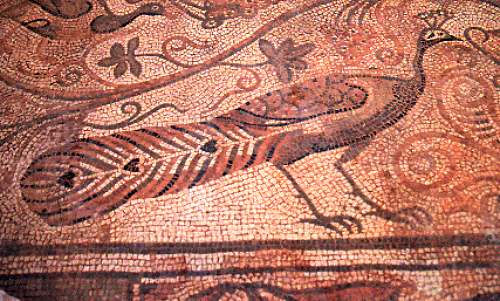
It stands out for preserving a floor mosaic of great beauty. It is the mosaic that configures the ritual compartmentalization of the interior, offering the following structure: the chamber is decorated with geometric motifs that frame small birds as a reference to paradise and creation, which are of a very Roman tradition. Between the nave and the head, we have a space decorated by the figures of two lions facing a palm tree, where there have been attempts to see reminiscences of the Jewish tradition, a community very flourishing in the Maó of those moments. The figures represent the power of death (the two lions) and the tree of life (the palm tree). Finally, in the head, the altar occupies the central place framed by vine shoots that emerge from a crater, as a symbol of life and abundance, and to which two peacocks are facing, representing the resurrection.