


Es Grau
This is a very extensive area, as it is the natural park and the largest wetland on the island of Menorca, which is why we will see it in two sections.
This one, which includes the town and the beach of Es Grau, the lagoon, a fundamental part and what determined this area to become a natural park, and we will include some of the beaches that are most accessible from this area, by paths on the coast of the park and closer to the town of Es Grau, the other route is developed in the Faro de Favàritx Area Circuit
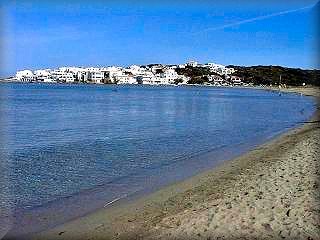
Es Grau beach gathers many qualities, some visible and others more subtle. It is a large, wide and very long stretch of sand, almost continuous, with a rock that is almost an islet now. The bay closes by continuing the beach with a rock wall until the exit, only interrupted by a small cove. The beach is quite crowded in the summer months, but it is surprising to see the large influx of walkers on mild winter days. The bathing season on this beach is very long, since being a deep inlet and having a large surface of dunes behind it, the sandy bottom penetrates many meters into the bay, making the descent  very gradual, even in the first 50 meters no variation is perceived. This provides two conditions: one, that the shallow water warms up faster and is less renewed, making bathing more pleasant at the beginning of the season when the open-sea coves are cold; furthermore, families with children or elderly people find the incentive of safety, which is why families from Mahón are frequent visitors to this beach, which is also very close to them, about six kilometers away.
It has rentals for boats and gadgets for nautical leisure and a permanent beach bar that is open all year round. It is a small hut whose popularity revolutionized its use and currently has tables on the sand under some tamarinds; it is a dream to sit and watch the sunset at the far end of the beach.
The town of Es Grau is small and seen from the beach, the houses that start from the hill, built in disorder and huddled together, go down hurriedly towards the coast and it seems that they are submerged in the sea, especially at sunset when the golden color floods the entire bay, softening even more the contrasts of the houses and the sea. The inhabitants of Es Grau, mostly Menorcans, perhaps for this reason, the urbanization of Es Grau has maintained minimal growth for many years and lacks the large tourist facilities of other coastal urbanizations.
It has several bars and restaurants with beautiful views, a pier, and even a shuttle service to the coves of the Isla de Colom and other virgin beaches of the park.
S'Albufera des Grau is the largest freshwater mirror in Menorca, the area can be visited on foot, it has a viewpoint and several points to be observed, as well as several marked paths and trails. The lagoon is an important transit point for thousands of birds that pass through the island every year on their migratory path between Africa and continental Europe, hence the importance of its preservation even in the surroundings; the laguna des Grau is separated from the sea by an area of dunes and a pine forest on the side closest to the urban area, being common to see groups spending the day alternating between the forest and the beach.
If you are going to visit the park, you can get information and ask for brochures at a hut designated for park rangers, located in one of the parking lots next to the sports area.
Isla de Colom
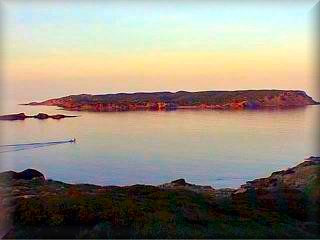
at the mouth of the entrance to the bay of Es Grau separated from Menorca by a narrow strip of water, about three meters deep and about 250 meters away, it is only recommended to cross the channel with small boats, in general with a sandy bottom with an area of reefs at the northern tip Cabo Mestral there is a slab, just as you turn to enter the bay of Es Grau.
Isla de Colom is private, but the beaches can be visited. If you do not have a boat, there is a shuttle service from the Es Grau pier that also makes trips through other areas of the park on a barge that makes several trips a day. The islet, in the part that faces the island of Menorca, on the side where the channel is, has two well-protected beaches of good size and fine sand, ideal for spending a few hours. There are abundant lizards, harmless, that prowl even up to the beach. From the outside, the islet presents a coast of cliffs; seen from the air, the islet resembles the map of Great Britain a lot.
The virgin beaches :
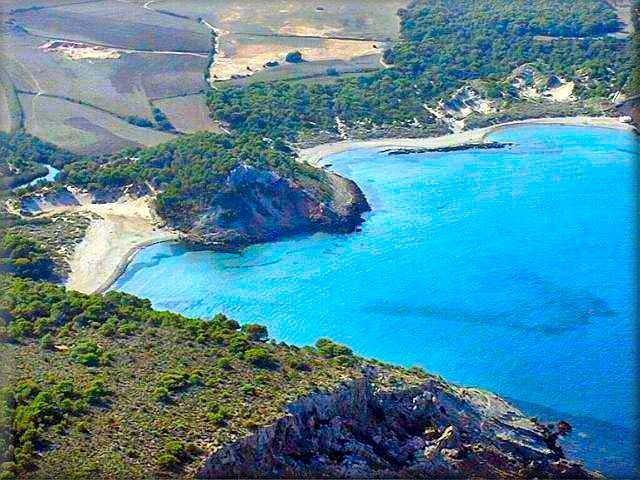
the S'Albufera des Grau park has a good handful of virgin beaches, six of them first-class. To take a tour of the park's beaches, we propose visiting only three beaches from this area, since the park is very extensive and it is recommended to visit the other beaches from the Faro de Favàritx area and from there it is easier to reach the other virgin beaches (if you want information see “Faro de Favàritx area”)
In these natural landscapes on the coast, there is only the urban center of Es Grau, and with the exception of some farmhouses (casas de payés), there is no construction other than a defense tower from the English period in the area of Sa Torreta beach. The cliff, very irregular in shape and height, has its own characteristics as it is a coast where black slate rock prevails. The coast has abundant seaweed and with the storms during the winter it is deposited on the sand; this includes the cove of Es Grau itself, but since it is in an urbanized area, it is collected, preferably by hand so as not to damage the ecosystem more than strictly necessary.
Cala Es Tamarells
with three beaches, the first one with pebbles and the other two with fine sand, the surroundings of these beaches invite you to take a walk, they are not crowded except for those who come in summer, generally by boat. We recommend a visit to the rocky point at the exit of the cove, on the right bank, “Punta de sa Pastera”; there are some holes in the rocks and the waves play at passing through them, jumping back and forth, leaving behind a trail of white foam, while in front we see one of the beaches of the Isla de Colom. We can also see some caves half-submerged in the water.
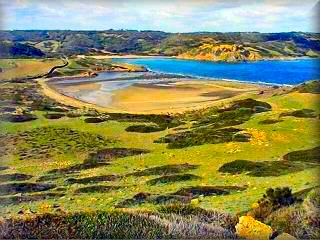
Cala de sa Torreta, the next cove to Tamarells, is about 10 minutes away, it is even less frequented, being a bit further away, it has two areas, one is a kind of bathing spot with very little depth and the other is a full-fledged beach with a deep stretch of sand that enters a small forest.
Excursions: From the parking lot in the pier area, take a narrow passage upwards, looking for the last street of the town. On this street and about a hundred meters away, a path (24) starts to the right that heads towards the cliffs and from the watchtowers we can see the Isla de Colom, the channel, the Sa Torreta area and the Faro de Favàritx in the background. The trail continues towards the open sea coast and is a pleasant walk suitable for everyone.
Access: To Es Grau.
From Maó, the M7 road that starts at the end of the port of Maó (in fact, it is the natural continuation), you pass a roundabout and the bridge and after about 500 meters, take the turnoff to the right along the M5 road that ends in Es Grau.
For the island of Colom, it is recommended that, if you do not come with a boat, you sign up for the transport that goes back and forth several times a day from the pier. It is not recommended to swim across the channel of about 150 meters, in summer there is a lot of boat traffic.
For the virgin beaches, ask at the pier about the boat departure, but the most natural and recommended way is to walk, unless, of course, you wish to visit the beaches of the Isla de Colom.
In the parking lot and sports area, just to the right upon arriving at Es Grao, there are some wooden cabins. These are tourist information points, specifically for the Parque d'es Grao. Consult the staff, and if you have a green card, you can even rent a bicycle to tour the park, especially the wetlands area.
If you visit in winter, you will not find informants; in that case, follow these instructions:
Walk directly to the Playa de Es Grao and walk around the entire beach. At the end, to the right, there is a clearly visible path that climbs the hill and crosses the forest on the other side. When it opens up to the valley, you will see the cove area of sa Torreta. Follow the path and you will arrive at the playas de Tamarels and s'Arenal del Moro.
For the area of the Parque d'es Grao lagoon, the "Albufera", there is a path that crosses it, as well as several elevated walkways designed to protect the vegetation. These run along part of the lagoon's coast and provide access to a viewpoint on high ground, offering panoramic views of the park and especially the lagoon.
Take the path that begins behind the typical Menorcan barriers (gates made of branch bars) located on the left if you are coming from Maó, just before the last curve entering the village. If you leave your car in the parking lot, walk back 200 meters and cross the road.
All that remains is to enter the park and venture into the forest along the path that emerges at the end of the beach. To the right, you go toward the village, and if you continue straight ahead, you reach the pristine beaches of the Es Grao park.
Of course, if you prefer, or after spending some time on the beach, you can take the path in the opposite direction and return to the parking lot through the forest. The walk takes about 15 to 20 minutes maximum and is suitable for all ages with no difficulty whatsoever.
Location map of the area of
Parque de la Albufera de Es Grao

Click on the map to enlarge it
Click here to go directly to the online map
Description of the points marked on the map of Es Grao
1-) Access road to Es Grao
2-) Main entrance point to the Parque de la Albufera de es Grao, access to the elevated paths to tour the floodable area within the park and reach the Albufera de Es Grao viewpoint
3-) Sports area and location of the information point for the Parque Natural de Es Grao
4-) Urban area of Es Grao
5-) Parking lot in front of the beach and location of the Spanish Red Cross emergency station during the summer to serve bathers.
6-) Playa de es Grao, an extensive sandy area with a very, very gentle entry into the sea, ideal for bathing for children and elderly people with reduced mobility or those who cannot swim.
7-) Point where the playa de Es Grao ends. If you continue along the path, you reach the other beaches of the park. If we take the left, we enter the area of the albufera de Es Grao, and we can reach the elevated paths to tour the Parque Natural. The first stretch runs along the edge of the forest and the dunes. The path is marked, and you should not leave the forest tracks. This area is an ANEI, an area of special interest, and therefore protected; this park has rangers.
8-) Small beach within the Bahía de Es Grao, just in front of the urban center and perfectly visible from the beach or the Es Grao pier area.
9-) Small and narrow beach on the Es Grao canal.
10-) Calo des Tamarell
11-) S'arenal d'en Moro, a type of marshland or swamp.
12-) Cala de sa Torreta; on one of the flanks of the cove, there is a defensive tower, one of many deployed along the entire perimeter of the Menorcan coast.
13-) Calo Morella Nou; this inlet consists of large stones pushed up by the sea.
14-) This beach is in the same Calo Morella Nou, with similar characteristics, but is somewhat more interesting than the one found next to it.
15-) Cala Tortuga; this beach is very beautiful and quiet. It is located in an extensive dune area, and just behind it is a wetland, the Laguna de Morella (16). To access it, it is best to take the road to the Faro de Favàritx.
16-) Wetland, just behind the Playa de cala Tortuga, "Laguna de Morella". In summer, it dries up completely, and the lagoon is hardly visible.
17-) Cala Capifort, very close to the playa de Tortuga.
18-) Cala Presili; of the beaches in this large inlet, it is the closest to the road and the faro de Favàritx itself. It is a few minutes' walk from where you should leave your car, which is right in the area of the playa de S'Escala. This is not marked on the map, as it is not a very interesting beach, and being next to the faro de Favàritx road, it has neither privacy nor much tranquility.
19-) Location of the faro de Favàritx. This is a highly visited lighthouse; the landscape is curious, beautiful, and full of geological contrasts, as two eras with different geological materials meet here. Slates predominate, giving the rock profile the appearance of books with black leaves.
In winter, during a storm, the landscape of the raging sea hitting the rocks on this peninsula is very spectacular.
Until recently, the faro de Favàritx was the end point of the Parque Natural de la Albufera des Grao, but now its extension reaches up to the limit of the Puerto de Addaya, in the vicinity of Arenal d'en Castell.
20-) Isla de Colom "Illa d'en Colom"
21-) Beach on the Isla de Colom
22-) Beach on the Isla de Colom
23-) Canal d'es Grao, about 150 meters wide and shallow; in some sections, it does not exceed 1.5 meters.
24-) Point where a path begins with a very interesting circuit to see the high cliffs and the profile of the north coast in the direction of La Mola de Maó. This area does not have beaches; the route consists mostly of high cliffs, and the path is wide and well-marked.
25-) Lagoon of the Parque Natural Albufera des Grao
Copyright Islademenorca.es, total or partial reproduction prohibited. Photographs: Omar Mauro Banquero